

INTRODUCTION
Polyendocrine metabolic ovarian syndrome (PMOS), formely known as Polycystic ovary syndrome (PCOS), is a multifactorial endocrine disorder affecting between 5 and 20% of women of reproductive age, depending on the diagnostic criteria applied (Rotterdam, National Institutes of Health [NIH], Androgen Excess and Polycystic Ovary Syndrome Society [AE-PCOS]).1–3 It is characterized by a variable combination of hyperandrogenism, chronic anovulation, and polycystic ovarian morphology. Beyond its reproductive impact, PCOS is increasingly recognized as a metabolic and inflammatory syndrome, associated with insulin resistance, dyslipidemia, central obesity, and increased cardiovascular risk.4–7
Type 1 diabetes (T1D), in contrast, is an autoimmune disease that leads to destruction of pancreatic β cells and absolute insulin deficiency.8,9 Its treatment requires lifelong exogenous insulin administration, which restores glycemic control but may result in chronic peripheral exposure to supraphysiological insulin concentrations. This pattern of exogenous hyperinsulinemia has been associated with alterations in ovarian function and the development of clinical features consistent with PCOS.10,11
The coexistence of PCOS and T1D, initially considered anecdotal, has been increasingly documented over recent decades. Its study is clinically relevant, as it provides a natural model of dissociation between insulin resistance and insulin exposure, allowing exploration of the direct effects of insulin on ovarian physiology and systemic metabolism.
In Mexico, this association is of relevance. The nutritional transition and the high prevalence of overweight and obesity among adolescents and young women have modified the clinical profile of T1D. According to the RENACED registry (2021), 38% of Mexican women with T1D present excess body weight, with a mean age at diabetes diagnosis of 11 years.12 This scenario represents a dual burden: the autoimmune component inherent to T1D and the metabolic inflammation derived from adipose tissue, both of which may potentiate ovarian dysfunction.
Since 2023, the study by García-Sáenz et al.13 has shown that the prevalence of PMOS among Mexican women with T1D reaches 39%, a figure within the upper range of estimates reported internationally and similar to other Latin American cohorts when Rotterdam-based criteria are applied.4 In this cohort, hirsutism and polycystic ovarian morphology were the most frequent components, whereas biochemical hyperandrogenism was less common.
More recently, a Mexican single-center exploratory study of proinflammatory markers in women with T1D and PMOS demonstrated that serum concentrations of interleukin-6 (IL-6) and tumor necrosis factor alpha (TNF-α) are independently associated with body mass index (BMI) and metabolic syndrome, but not with the diagnosis of PCOS.14 These findings suggest that systemic inflammation in T1D is primarily determined by metabolic and adipose status, and that the ovary acts predominantly as a target organ rather than as a primary source of inflammation.
Recent evidence further suggests that the association between T1D and PMOS should be interpreted within a broader spectrum of androgen excess disorders. In a contemporary cohort evaluated using state-of-the-art analytical techniques, up to one quarter of women with T1D presented an undiagnosed hyperandrogenic disorder. The classic PMOS phenotype was the most frequent, although with milder clinical and biochemical manifestations. These findings reinforce the notion that hyperandrogenism in T1D may be underdiagnosed and that its expression differs from that observed in classic PMOS in the general population.15
The aim of this review is to integrate the clinical, metabolic, and immunological evidence supporting the interaction between PMOS and T1D, with particular emphasis on the Mexican population, and propose an emerging immunometabolic model integrated to the pathophysiology of PMOS in this specific context.
METHODS
This article was designed as a narrative review. The structure and reporting of the manuscript were guided by the Scale for the Assessment of Narrative Review Articles.
A targeted literature search was conducted in PubMed/MEDLINE from database inception to June 2025. The search was organized into three thematic domains: PCOS/hyperandrogenism, T1D/autoimmune diabetes, and inflammation/immunometabolic dysfunction. Synonyms and related terms within each domain were combined with OR, and the three domains were subsequently combined with AND to identify literature addressing the intersection between ovarian dysfunction, autoimmune diabetes, and inflammatory-metabolic risk.
The search was complemented by a manual review of reference lists from relevant articles. Priority was given to original studies, systematic reviews, meta-analyses, international guidelines, and studies conducted in Latin American or Mexican populations when available. The final selection of articles was based on relevance to the clinical, metabolic, reproductive, and immunoinflammatory interaction between PMOS and T1D.
EPIDEMIOLOGY AND PREVALENCE
The prevalence of PMOS among women with T1D varies widely across international cohorts, ranging from 7.4 to 49%, depending on population characteristics, age distribution, diagnostic criteria, and androgen assessment methods. Latin American cohorts, particularly those from Chile and Mexico, have reported prevalences close to 40% when Rotterdam-based criteria are applied. To facilitate comparison across studies, Table 1 summarizes the main cohorts evaluating PMOS in women with T1D, including country, sample size, PMOS prevalence, diagnostic criteria, obesity or body composition data, and insulin dose per kilogram of body weight when available.4,5,10,16,17
Table 1. Differences in PCOS prevalence in women with T1D across studies and diagnostic criteria
| Study | Country | n(T1D) | PMOS prevalence (%) | Diagnostic criteria | Obesity/body composition data | Insulin dose | References |
|---|---|---|---|---|---|---|---|
| Escobar-Morreale et al. (2000) | Spain | 85 | 19 | NIH | Obesity NR; BMI in PCOS: 23.5 ± 3.1 kg/m2 | 0.7 ± 0.4 U/kg/day in PMOS | 18 |
| Codner et al. (2006) | Chile | 42 | 40.5 | ESHRE/ASRM Rotterdam | Obesity NR; overall BMI in T1D 24.5 ± 0.5 kg/m2 | 0.1 U/kg/day, overall T1D | 10 |
| Bizzarri et al. (2011) | Italy | 54 | 7.4 | ESHRE/ASRM Rotterdam | Obesity prevalence NR; Overall BMI: 24.9 ± 3.0 kg/m2 | MI: 1.0 ± 0.1 U/kg/day; CSII: 0.6 ± 0.1 U/kg/day; none reported by PMOS | 19 |
| Amato et al. (2014) | Italy | 103 | 36.9 | AE-PCOS | Obesity prevalence NR; BMI in T1D + PMOS: 22.79 ± 3.8 kg/m2 | 0.71 ± 0.16 U/kg/day in T1D + PMOS | 11 |
| Busiah et al. (2017) | France | 53 | 47.9 | ESHRE/ASRM, NIH | Obesity prevalence NR; report in BMI Z-Score 1.2 (−0.9-3.9) | 1.1 (0.7-1.5) U/kg/day in T1D + PMOS | 20 |
| Braham et al. (2017) | Saudi Arabia | 102 | 15.7 | ESHRE/ASRM Rotterdam | Overall cohort: 26.8% overweight and 2.8% obesity; NR prevalence in PMOS; BMI in PMOS: 25.3 ± 4.77 kg/m2 | 0.83 ± 0.2 U/kg/day, overall cohort | 21 |
| Gunness et al. (2018) | Ireland | 87 | 18 | NIH | Obesity prevalence NR; BMI in T1D + PMOS 23.4 ± 5.0 kg/m2 | NR; eGDR in T1D + PMOS: 10.1 ± 2.0 mg/kg/min | 22 |
| Castro-Correia et al. (2018) | Portugal | 42 | 19 | ESHRE/ASRM | Excess weight defined as BMI ≥ 85th percentile: 43% | NR. | 23 |
| Thong et al. (2020) | United Kingdom | 115 | 16.5 | Self-reported PMOS; forma diagnostic criteria not available | Overall T1D cohort: overweight 40.4%, obesity 14%; overall BMI in T1D: 25 (23.1-28.2) kg/m2 | NR | 16 |
| Lebkowska et al. (2021) | Poland | 83 | 49 | ESHRE/ASRM, NIH, AE-PCOS | Obesity prevalence NR; BMI in T1D + PMOS: 25 (22-26) kg/m2 | 0.5 (0.4-0.6) U/kg/day in T1D + PMOS | 24 |
| Dominic et al. (2023) | India | 65 | 27 | ESHRE/ASRM, NIH, AE-PCOS | Obesity prevalence NR; BMI in T1D + PMOS: 21.5 (20.1-23.8) kg/m2 | 1.05 (0.79-1.31) U/kg/day in T1D + PMOS | 25 |
| García-Sáenz et al. (2023) | Mexico | 41 | 39 | ESHRE/ASRM, NIH, AE-PCOS | In T1D + PCOS: overweight 37.5%, obesity 12%; BMI in T1D + PMOS 25.87 ± 3.6 kg/m2 | 1.04 ± 0.33 U/kg/day in T1D + PMOS | 13 |
Differences in PMOS prevalence across studies and diagnostic criteria. Data are shown as reported in the original studies. PMOS prevalence may vary according to the diagnostic criteria applied. Obesity, BMI, and insulin dose data are shown when available; when not reported specifically for the PMOS subgroup, overall cohort values are presented. Insulin dose refers to the total daily insulin dose per kilogram of body weight unless otherwise stated.
AE-PCOS: Androgen Excess and Polycystic Ovary Syndrome Society; ASRM: American Society for Reproductive Medicine; BMI: body mass index; CSII: continuous subcutaneous insulin infusion; eGDR: estimated glucose disposal rate; ESHRE: European Society of Human Reproduction and Embryology; MI: multiple insulin injections; NIH: National Institutes of Health; NR: not reported; PMOS: polyendocrine metabolic ovarian syndrome; T1D: type 1 diabetes.
In the systematic review and meta-analysis by Bayona et al.,4 which included 1042 women with T1D, the pooled prevalence of PMOS was 26%, with substantial heterogeneity depending on whether Rotterdam, NIH, or AE-PCOS diagnostic criteria were applied. Among individual studies, the highest prevalences were reported by Lebkowska et al. (49%), Busiah et al. (48%), and Codner et al. (40%). Studies conducted in Latin American populations also reported relatively high prevalences, ranging from approximately 23 and 40.5%.
The Mexican study by García-Sáenz et al. reported a PMOS prevalence of 39%, one of the highest frequencies reported to date. This cross-sectional cohort included 41 women with T1D treated at a tertiary referral center and evaluated PMOS using the European Society of Human Reproduction and Embriology/American Society for Reproductive Medicine (ESHRE/ASRM) Rotterdam criteria, with additional classification according to AE-PCOS and NIH criteria. Before PMOS classification, other causes of hyperandrogenism or menstrual dysfunction, including hyperprolactinemia, uncontrolled hypothyroidism, and congenital adrenal hyperplasia, were excluded. Operational diagnostic components included clinical hyperandrogenism, biochemical hyperandrogenism, oligomenorrhea, and polycystic ovarian morphology. Clinical hyperandrogenism was defined mainly by hirsutism, whereas biochemical hyperandrogenism was less frequent. PMOS prevalence was 39% according to ESHRE/ASRM criteria, 31.7% according to AE-PCOS criteria, and 14.6% according to NIH criteria. The most frequent component was polycystic ovarian morphology. Regarding body composition, 36.6% of the overall cohort had overweight and 12.2% had obesity. Among women with T1D and PMOS, 37.5% had overweight and 12.5% had obesity, compared with 36 and 12%, respectively, among women without PCOS. Although BMI and the estimated glucose disposal rate (eGDR) values did not differ significantly between groups, women with PMOS required higher daily insulin doses than those without PMOS (1.04 ± 0.33 IU/kg/day vs. 0.71 ± 0.29 IU/kg/day; p = 0.003). In addition, insulin resistance, defined by eGDR < 7.32 mg/kg/min, was more frequent in women with PMOS. These findings are consistent with the hypothesis that therapeutic hyperinsulinemia, together with metabolic susceptibility, may contribute to ovarian dysfunction in women with T1D.13
The variability in reported PMOS prevalence among women with T1D may be partially explained by methodological differences across studies. The predominant use of immunoassays for androgen measurement and the application of reference ranges derived from the general population may lead to both overdiagnosis and underdiagnosis of hyperandrogenism in T1D. More recent studies employing liquid chromatography-mass spectrometry and direct measurement of free testosterone suggest more accurate prevalence estimates and a finer phenotypic characterization of androgen excess disorders in this population.15,26
This geographic variation suggests that environmental context and body composition influence the clinical expression of PMOS in T1D. The higher prevalence observed in Mexico and Latin America may result from the interaction between therapeutic hyperinsulinemia and central adiposity, which together potentiate ovarian dysfunction.
In addition, a 2025 study evaluating inflammatory markers reported that the prevalence of metabolic syndrome among Mexican women with T1D reaches 35.1%, and that its presence is associated with higher circulating levels of IL-6 (r = 0.45, p < 0.01) and TNF-α (r = 0.41, p < 0.01)14. These findings further support the concept that PMOS in T1D develops within a metabolically driven inflammatory environment rather than as a primary ovarian disorder.
SHARED PATHOPHYSIOLOGICAL MECHANISMS BETWEEN PMOS AND T1D
The coexistence of PMOS and T1D represents a highly complex pathophysiological model in which endocrine, metabolic, and immune alterations converge. In Mexican women, three fundamental axes explain this interaction:
These mechanisms may act synergistically to disrupt the hypothalamic-pituitary-ovarian axis and peripheral metabolism, shaping an emerging immunometabolic phenotype.
The interaction between exogenous hyperinsulinemia, adipose tissue-driven inflammation, ovarian dysfunction, and endothelial impairment in women with T1D is summarized in figure 1.
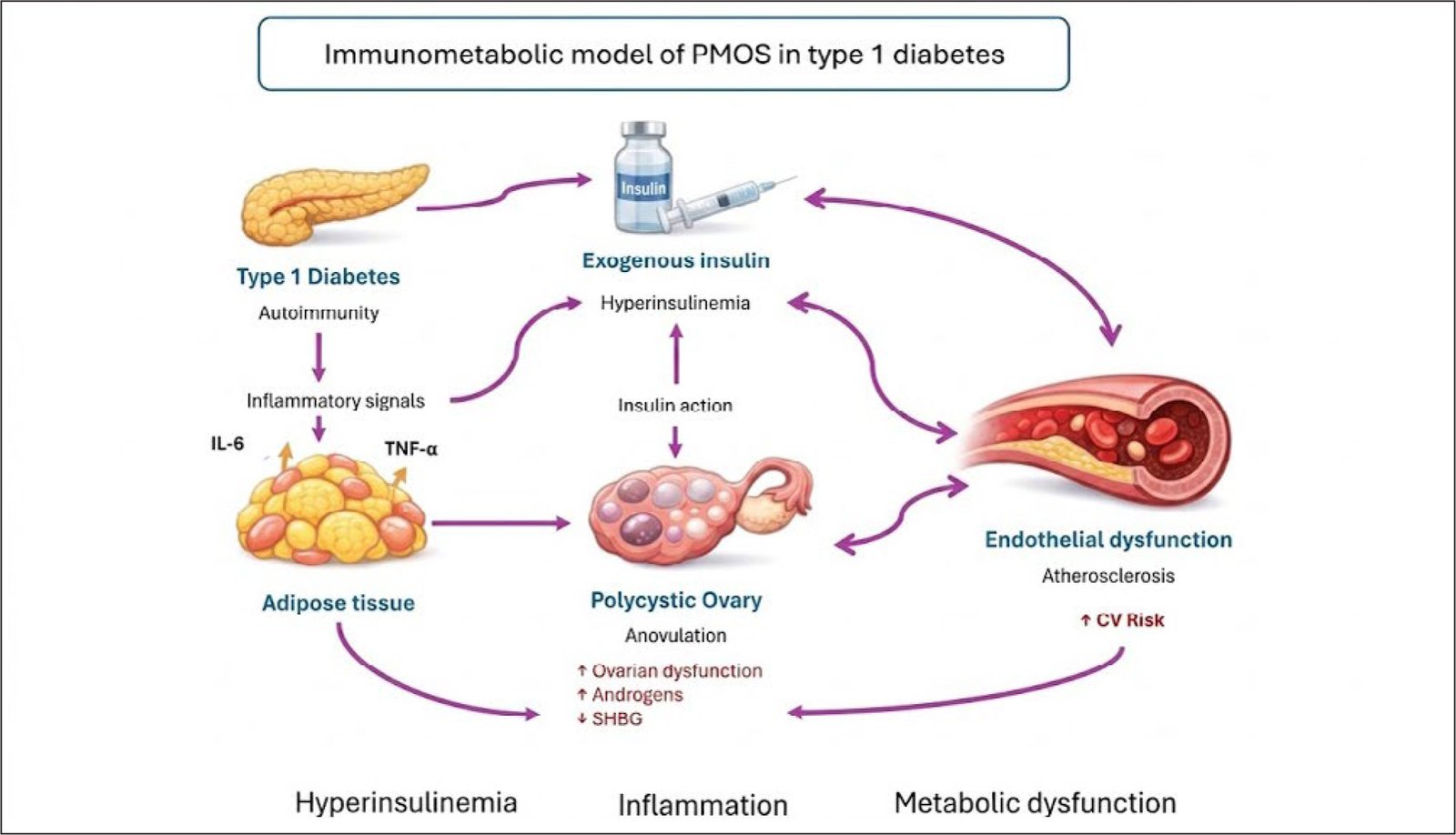
Figure 1. Immunometabolic model of PCOS in type 1 diabetes (T1D). Exogenous insulin therapy in T1D leads to chronic peripheral hyperinsulinemia, which directly stimulates ovarian steroidogenesis and amplifies androgen production. Concurrently, central adiposity promotes adipose tissue-derived inflammation characterized by increased interleukin-6 and tumor necrosis factor-alpha, contributing to insulin resistance and endothelial dysfunction. The ovary acts as a target organ within this immunometabolic network, resulting in ovarian dysfunction, hyperandrogenic features, and increased cardiovascular risk.
EXOGENOUS HYPERINSULINEMIA AND DIRECT OVARIAN ACTION
Insulin is a hormone with well-recognized secondary gonadotropic effects. In the ovary, insulin acts through its own receptors in theca and granulosa cells, potentiating luteinizing hormone (LH) action and stimulating the expression of CYP17A1, a key enzyme in androgen biosynthesis.27,28
Under physiological conditions, portal insulin concentrations exceed peripheral levels, allowing modulation of hepatic insulin action without systemic overexposure. However, subcutaneous insulin administration disrupts this gradient, leading to chronic peripheral hyperinsulinemia. This phenomenon has been extensively documented in women with T1D receiving intensive insulin regimens.29
Codner et al.10 observed that polycystic ovarian morphology was significantly more frequent in women with T1D treated with ≥ 3 daily insulin injections (75%) compared with those receiving less intensive insulin regimens (33%). This effect appeared to be independent of glycemic control, suggesting a direct gonadotropic action of insulin on the ovary.
In addition, insulin reduces hepatic synthesis of sex hormone-binding globulin (SHBG), thereby increasing the free fraction of testosterone. This mechanism may explain the presence of clinical hirsutism despite normal total testosterone levels reported in the Mexican cohort.13
At the molecular level, insulin and LH converge on the PI3K/Akt/mTOR signaling pathway, promoting theca and follicular growth. Chronic exposure to elevated insulin levels induces hyperplasia of the theca interna, stromal expansion, and follicular growth arrest, ultimately leading to the characteristic polycystic ovarian morphology.28,30,31
Thus, therapeutic hyperinsulinemia acts as an amplifying factor of androgenic steroidogenesis, independently of classical insulin resistance, and constitutes the core endocrine disturbance in PMOS associated with T1D.
ADIPOCYTE-DEPENDENT SYSTEMIC INFLAMMATION
For many years, both PMOS and T1D were assumed to share a state of chronic low-grade inflammation. However, recent findings in the Mexican population refine this interpretation when both conditions are present.
The study by García-Sáenz et al. demonstrated that circulating levels of IL-6, TNF-α, and C-reactive protein (CRP) do not differ significantly between women with T1D with and without PMOS, but are markedly elevated in the presence of obesity or metabolic syndrome.14 These findings support a model in which the ovary functions as a target organ of an adverse immunometabolic environment rather than as a primary source of inflammation.
IL-6, of which approximately 15-35% is secreted by adipose tissue, acts as an endocrine mediator that stimulates hepatic CRP synthesis and promotes insulin resistance through activation of SOCS3, which inhibits insulin receptor substrate 1 (IRS-1) phosphorylation.32,33 In parallel, TNF-α induces insulin resistance through serine phosphorylation of IRS-1 and negatively modulates glucose transporter 4 expression in muscle and adipose tissue.34
This systemic inflammatory pattern perpetuates a vicious cycle: exogenous insulin and adipose tissue inflammation increase visceral fat storage, which in turn enhances cytokine production. In women with T1D, the combination of therapeutic hyperinsulinemia and central obesity amplifies the proinflammatory state, creating a permissive environment for ovarian dysfunction.
In the Mexican context, where overweight and obesity affect more than 70% of adult women and nearly 40% of adolescents with T1D present excess body weight.12,35 this mechanism acquires relevance. The ovary is not the primary generator of inflammation, but rather the organ that manifests its endocrine consequences.
OXIDATIVE STRESS AND INFLAMMATION
Recent studies in women with classic PMOS have shown that hyperandrogenism is associated with increased oxidative stress, elevated proinflammatory cytokines, and DNA damage, particularly in hyperandrogenic phenotypes. However, these studies systematically exclude women with diabetes and evaluate contexts dominated by endogenous hyperandrogenism and insulin resistance.36,37
Therefore, direct extrapolation of these mechanisms to PMOS associated with T1D should be approached with caution, as available evidence in this setting suggests that adiposity and metabolic imbalance remain the main determinants of oxidative stress and systemic inflammation.
CYTOKINES AND CROSS-SIGNALING
The impact of proinflammatory cytokines on ovarian function is multifaceted.
Together, these cytokines modulate both peripheral insulin sensitivity and ovarian responsiveness to gonadotropins, constituting an inter-organ inflammatory network connecting adipose tissue, liver, pancreas, endothelium, and ovary.
Mexican research provides evidence that this network is hyperactivated by obesity and excess insulin, but not necessarily by the presence of PMOS itself. This nuance redefines the traditional interpretation of PMOS in T1D: rather than a primary inflammatory ovarian disease, it represents an ovarian manifestation of systemic metabolic inflammation.
IMMUNOMETABOLIC CONVERGENCE
The concept of immunometabolic convergence proposes a bidirectional interaction between inflammation and energy metabolism. Although T1D is primarily an autoimmune disease, it generates metabolic disturbances that feed back into inflammation through oxidative stress, reactive oxygen species, and activation of Nuclear Factor kappa B (kB)
signaling.44
In PMOS, androgen excess promotes central lipolysis and the release of free fatty acids, which activate Toll-like receptor in macrophages, inducing IL-6 and TNF-α production. In women with T1D, this process is further potentiated by hyperinsulinemia and adipocyte dysfunction, resulting in a hybrid inflammatory microenvironment in which autoimmune and metabolic inflammatory mechanisms converge.
In the Mexican population, this model is accentuated by genetic predisposition to visceral adiposity and subclinical inflammatory states.6,23 Consequently, PMOS associated with T1D can be understood as an immunometabolic phenotype, representing the expression of a functional axis involving three key organs: the autoimmune pancreas, the inflamed adipocyte, and the hyperresponsive ovary.
METABOLIC AND CARDIOVASCULAR IMPLICATIONS
Metabolic risk in women with both PMOS and T1D is greater than that associated with either condition alone.
In the Mexican cohort, women with PMOS-T1D required higher insulin doses (1.04 ± 0.33 IU/kg/day vs. 0.71 ± 0.29 IU/kg/day; p = 0.003) and exhibited lower eGDR (7.1 ± 2.3 vs. 9.3 ± 2.8 mg/kg/min), indicating functional insulin resistance.13 This phenomenon does not reflect intrinsic defects in insulin receptor signaling, but rather peripheral saturation induced by intensive insulin therapy and metabolic inflammation.
IL-6 and TNF-α play critical roles in endothelial dysfunction. At the vascular level, both mediators reduce nitric oxide bioavailability, increase the expression of adhesion molecules (intercellular adhesion molecule 1, vascular cell adhesion molecule-1), and facilitate monocyte infiltration into the endothelium.32,33 These processes contribute to arterial stiffness and early atherogenesis, which has already been described in young women with T1D.
In Mexico, where cardiovascular disease remains the leading cause of mortality among women, this immunometabolic profile acquires clinical relevance. The PMOS-T1D phenotype may be considered an early proatherogenic state driven by hyperinsulinemia, adipose tissue inflammation, and endothelial dysfunction.
Moreover, the increase in IL-6 observed in overweight Mexican women suggests that weight management may exert anti-inflammatory and vasoprotective effects, potentially exceeding those achieved by isolated pharmacological interventions.
Overall, the coexistence of PMOS and T1D amplifies cardiometabolic risk through mechanisms that are predominantly metabolic rather than hormonal, redirecting preventive strategies toward systemic inflammatory modulation and optimization of body composition.
REPRODUCTIVE AND HORMONAL CONSEQUENCES
PMOS associated with T1D exhibits an atypical clinical profile compared with classic PMOS. In the Mexican cohort, the most frequent features were polycystic ovarian morphology (58.5%) and hirsutism (41.5%), whereas biochemical hyperandrogenism was less prevalent (19.5%).13
This pattern suggests that ovarian dysfunction is driven more by hyperinsulinemia and reduced SHBG levels than by intrinsic androgen overproduction. In other words, the ovary displays an exaggerated response to a metabolically altered environment without necessarily developing an independent pathological steroidogenic process.
Clinically, patients may present with mild menstrual irregularities, oligo-ovulation, or intermittent anovulatory cycles; however, most retain partial ovulatory function and reproductive potential, particularly when glycemic control is adequate.
Previous studies in adolescents with T1D have shown that menstrual irregularities may affect up to 60% of cases but tend to improve following treatment optimization and metabolic stabilization.10,45,46 Therefore, PMOS in this context should not be regarded as a structural infertility disorder, but rather as a potentially reversible dysfunction modulated by the immunometabolic environment.
In Mexican endocrinology practice, this approach has relevant implications: screening for PMOS in women with T1D should focus on clinical assessment of hyperandrogenism and ovarian morphology rather than on serum androgen levels, which are frequently within normal ranges.
THERAPEUTIC IMPLICATIONS
Management of PMOS in women with T1D requires a comprehensive strategy oriented toward three main objectives:
Glycemic control and reduction of hyperinsulinemia
The proper use of insulin therapy is essential. The use of long-acting basal insulin analogues (glargine, degludec) with an adequate use of prandial insulins or continuous subcutaneous insulin infusion systems reduces peripheral insulin peaks and, consequently, the gonadotropic stimulus on the ovary.10,11
In cases of overweight or relative insulin resistance, metformin has shown consistent benefits, including improved peripheral insulin sensitivity, reduced daily insulin requirements, normalization of menstrual cycles, and reduction of the free androgen index.7,23 Although its use in T1D is off-label, its safety profile is well documented in young women with stable glycemic control.
Adiposity and lifestyle intervention
Reduction of central adipose tissue has a direct impact on circulating IL-6 and TNF-α levels. Structured aerobic exercise programs (≥ 150 min/week) combined with a hypocaloric anti-inflammatory diet (rich in monounsaturated fatty acids and omega-3 fatty acids) have been shown to decrease inflammatory markers and improve menstrual regularity.42,47
In Mexican women, dietary intervention is particularly relevant given the high intake of simple carbohydrates and saturated fats. Nutrition education programs for T1D could incorporate specific components targeting ovarian and hormonal health.
Management of clinical hyperandrogenism
Treatment of hirsutism and acne may include combined oral contraceptives containing non-androgenic progestins (drospirenone, cyproterone) and, in selected cases, spironolactone or topical antiandrogens. However, in women with T1D, combinations that increase thrombotic or adverse lipid risk should be avoided.48,49
Therapeutic decisions should be individualized, prioritizing metabolic stability and avoiding polypharmacy.
Cardiovascular prevention
The PMOS-T1D phenotype is associated with subclinical endothelial dysfunction. Therefore, periodic assessment of lipid profile, blood pressure, high-sensitivity CRP, and eGDR is recommended.
Supplementation with vitamin D, inositol, or omega-3 fatty acids may exert modest anti-inflammatory effects and improve insulin sensitivity; however, evidence in T1D remains limited.42,47
RESEARCH PERSPECTIVES
Recognition of PMOS as a metabolically modulated entity in Mexican women with T1D opens new avenues for scientific investigation.
MICRORNAS AND EXOSOMES
Emerging evidence suggests that extracellular vesicles and their microRNA cargo may participate in ovarian intercellular communication and in the pathophysiology of PMOS. Differential miRNA profiles have been described in granulosa cells, follicular fluid, and extracellular vesicles from women with PMOS, involving pathways related to cytokine signaling, insulin sensitivity, oxidative stress, and follicular dysfunction. In particular, miR-21 and miR-93 have been linked to hyperandrogenic PMOS phenotypes, whereas miR-146a and other insulin-sensitivity-related miRNAs have been associated with inflammatory and metabolic markers in the ovarian microenvironment.50–53
CYTOKINES AS PROGNOSTIC BIOMARKERS
The finding of elevated IL-6 and TNF-α levels in women with obesity and T1D suggests that quantification of these cytokines could be used to stratify metabolic risk. In Mexican populations, integration of these biomarkers with clinical indices, such as eGDR and BMI could allow the development of predictive models adapted to the local context.
PERSONALIZED ANTI-INFLAMMATORY INTERVENTION
The development of therapies targeting specific cytokines, such as IL-1β antagonists (anakinra) or TNF-α inhibitors, is currently at an experimental stage. Although their use in PMOS is not routine, they could be evaluated as a potential therapeutic strategy for women with T1D and persistent inflammatory phenotypes.
CONCLUSION
PMOS associated with T1D should be considered an emerging immunometabolic entity rather than a simple diagnostic coincidence. In Mexican women, this syndrome reflects the interaction between exogenous hyperinsulinemia, adipose tissue-dependent inflammation, and ovarian susceptibility.
National exploratory evidence suggest that IL-6 and TNF-α levels are closely related to obesity and metabolic syndrome, rather than to the presence of PMOS per se. Thus, systemic inflammation constitutes the context in which the ovary manifests a secondary hyperandrogenic phenotype.
From a clinical perspective, management of PMOS-T1D should prioritize metabolic modulation targeting body weight, insulin sensitivity, and lifestyle-over isolated hormonal treatment. Early detection of ovarian dysfunction and integration of inflammatory biomarkers may improve the prevention of reproductive and cardiovascular complications.
ACKNOWLEDGMENT
We thank Sociedad Mexicana de Nutrición y Endocrinología for the funding provided for this research project.
FUNDING
Funding was received from the Sociedad Mexicana de Nutrición y Endocrinología.
CONFLICTS OF INTEREST
C. Ramírez-Rentería, Editor-in-Chief of the journal, was not involved in the editorial handling, peer review, or decision-making process for this manuscript because she is a co-author. The manuscript was assigned to an independent editor and evaluated under the journal’s standard blinded peer-review procedures. The remaining authors declare no conflicts of interest.
ETHICAL CONSIDERATIONS
Protection of humans and animals. The authors declare that no experiments on humans or animals were performed for this research.
Confidentiality, informed consent, and ethical approval. The study does not involve personal data, medical records, or human biological samples; therefore, it does not require ethical approval. The SAGER guidelines do not apply.
Statement on the use of artificial intelligence. The authors declare that ChatGPT was used for translation and to improve the English wording.
